
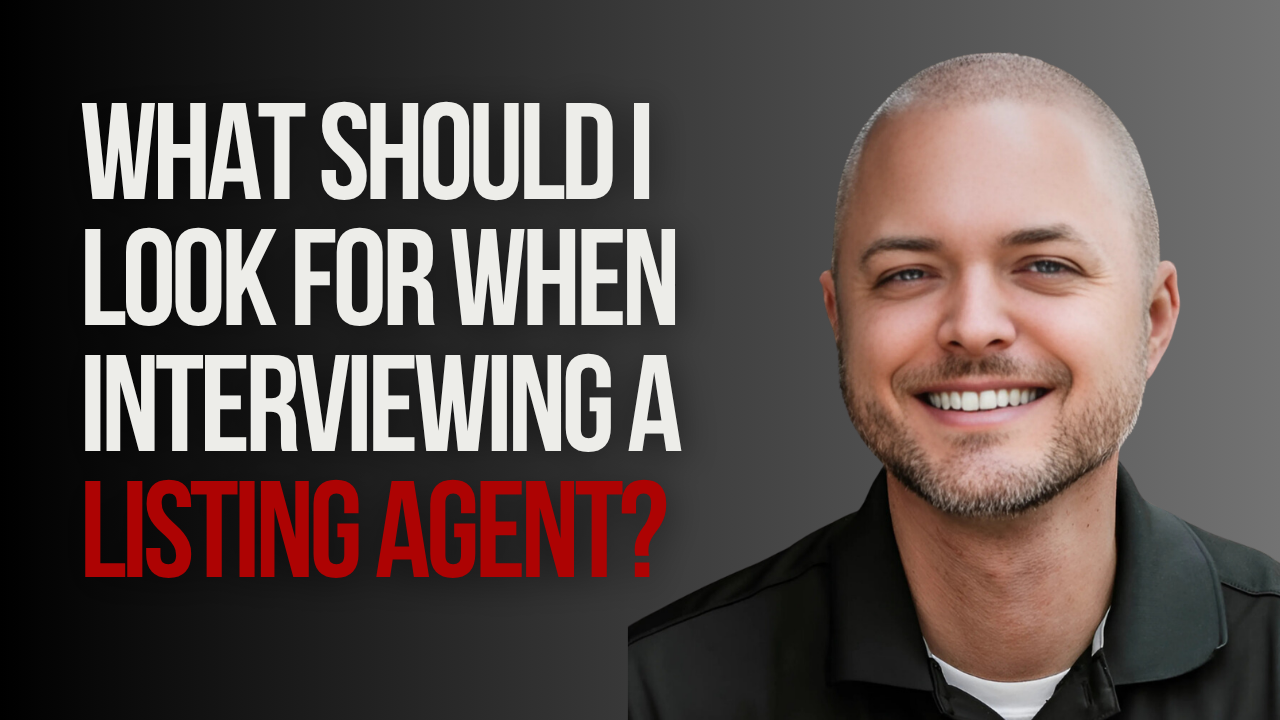
What Should I Look for When Interviewing a Listing Agent?
Selling your home is one of the biggest financial decisions you will make.
So why do so many homeowners choose their listing agent based on who they like, who was referred by a friend, or—sometimes—the agent who tells them the highest price?
I get it.
Selling a home can be emotional. You want someone you trust. You want someone who will take care of you. And, naturally, you want to get as much money as possible.
But here’s the problem:
The agent who promises you the highest price isn’t necessarily the agent who will get you the highest price.
After more than a decade in real estate, I’ve sat across the table from a lot of homeowners preparing to sell. I’ve also seen what happens when a home is priced incorrectly, marketed poorly, or handled by an agent who doesn’t have a real strategy once things don’t go according to plan.
The good news?
You don’t have to be a real estate expert to choose a great listing agent.
You just need to ask better questions.
Here’s what I would look for if I were interviewing a real estate agent to sell my own home.
Start With Experience—But Ask What Kind
Experience matters.
But simply asking, “How long have you been in real estate?” doesn’t tell you nearly enough.
An agent who has been licensed for 20 years isn’t automatically better than someone who has been in the business for eight.
I’d want to know what they’ve actually been doing during those years.
Ask questions like:
How many homes do you personally list each year?
How many homes have you sold in my price range?
How familiar are you with my neighborhood?
Do you primarily work with buyers, sellers, or both?
How many transactions do you personally handle?
How much of the process is handled by you versus an assistant or team member?
There’s an important distinction here.
Years in the business are one measurement of experience. Relevant experience is another.
If you’re selling a $600,000 suburban home, for example, I’d want an agent who understands the buyers, competition, pricing, and expectations surrounding homes like yours.
You don’t need the agent who has sold the most houses.
You need the agent who understands your house and your market.
Ask How They Arrived at Their Recommended Price
This may be the single most important question you ask.
And don’t simply ask:
“What do you think my house is worth?”
Ask:
“How did you arrive at that price?”
There’s a big difference.
A professional listing agent should be able to walk you through the data and explain their reasoning.
They should be looking at things like:
Recent comparable sales
Current competition
Pending sales
Location
Condition
Updates and improvements
Size and layout
Market activity
Buyer demand
How quickly comparable homes are selling
But there’s something else you need to understand.
The highest list price isn’t always the best strategy.
I’ve seen homeowners choose an agent because Agent A said their home was worth $450,000 while Agent B said $425,000.
It feels like an easy decision.
“Obviously, I’m going with the agent who thinks I can get $450,000.”
Not necessarily.
What if the $450,000 agent is simply telling you what you want to hear?
If the house sits on the market for 60 days, gets little activity, requires multiple price reductions, and eventually sells for $410,000, that initial $450,000 estimate didn’t do you much good.
Pricing isn’t about winning the listing appointment. It’s about positioning the home to win in the marketplace.
That’s a very different thing.
Ask, “What’s Your Marketing Plan?”
If an agent’s entire marketing plan is:
“We’ll put it in the MLS and it will automatically go to Zillow.”
I’d keep interviewing.
MLS exposure is important. Obviously.
But it’s not a marketing strategy. It’s the starting point.
Ask what happens before the listing goes live.
A strong agent should be thinking about:
Preparing the home
Staging recommendations
Photography
Floor plans
Property descriptions
Online presentation
Social media
Agent-to-agent promotion
Buyer targeting
Launch strategy
Showing strategy
The goal isn’t simply to get your home seen.
The goal is to get the right buyers interested enough to take action.
That’s an important distinction.
You can have 10,000 people scroll past your listing and accomplish very little.
Or you can put the home in front of the right people, create perceived value, generate showings, create urgency, and ultimately generate offers.
That’s what marketing is supposed to do.
Ask About the First 14 Days
One of my favorite questions for a listing agent is:
“What is your plan for the first two weeks?”
Why?
Because your launch matters.
The first days on the market are when your listing is brand new. Buyers and agents are paying attention. Your listing can create excitement—or it can become another house people scroll past.
I want an agent who has thought through the launch before we ever put the sign in the yard.
Then ask the follow-up question:
“How will we know if the strategy is working?”
This is where you separate a salesperson from a strategist.
A good agent should be watching:
Number of showings
Buyer feedback
Online activity
Showing-to-offer activity
Competition
New listings
Price changes
Market trends
And then they should be willing to adjust based on what the market tells us.
Because here’s the uncomfortable truth:
The market doesn’t care what we hoped the house would sell for.
The market gives us feedback.
Our job is to listen.
Ask What Happens If Your House Doesn’t Sell
This question is incredibly important.
Anyone can tell you what they’ll do if everything goes perfectly.
But what happens when it doesn’t?
Ask:
“What happens if we don’t get showings?”
Then:
“What happens if we get showings but no offers?”
And finally:
“At what point would you recommend changing the price or strategy?”
You want to hear an actual process.
Maybe the problem is price.
Maybe it’s presentation.
Maybe the marketing isn’t creating enough interest.
Maybe there’s more competition than expected.
Maybe the market has shifted.
Whatever the reason, you want an agent who is comfortable diagnosing the problem rather than simply waiting and hoping.
“Let’s give it another couple of weeks” isn’t a strategy.
Sometimes waiting is absolutely the right decision.
But your agent should be able to explain why you’re waiting and what you’re watching for.
Don’t Forget About Negotiation
Getting an offer isn’t the finish line.
It’s where the real work often begins.
A good listing agent should be prepared to help you evaluate:
Purchase price
Financing
Inspection contingencies
Appraisal
Closing date
Seller concessions
Contingencies
Earnest money
Risk
Probability of closing
This is another area where the highest offer isn’t always the best offer.
Imagine you receive two offers.
One is $10,000 higher but has several contingencies and a higher risk of falling apart.
The other is slightly lower but comes with stronger terms and much greater certainty of closing.
Which one is better?
That’s not a question you should have to answer alone.
Your listing agent should be able to explain the tradeoffs and help you make an informed decision.
Find Out How They Communicate
This sounds simple.
It’s not.
Communication is one of the biggest differences between a good real estate experience and a miserable one.
Before hiring an agent, ask:
How often will we communicate?
How quickly do you typically respond?
Who will I contact with questions?
Will I communicate directly with you?
Who handles showings?
Who handles the paperwork?
Who handles problems?
Here’s a question I really like:
“If I call you on a Tuesday afternoon with a question, who am I actually going to talk to?”
There’s nothing wrong with a team.
In fact, a great team can provide tremendous service.
But you should understand the structure before you sign the listing agreement.
You shouldn’t discover after the listing goes live that the person who promised to personally handle everything has handed most of it to someone else.
Ask What Is Actually Included in Their Fee
Yes, you should ask about commission and compensation.
You should understand exactly what you’re agreeing to pay.
But don’t make the mistake of comparing agents based solely on percentage.
Instead, ask:
“What do I receive for that fee?”
Find out what’s included.
For example:
Professional photography
Marketing
Floor plans
Advertising
Listing preparation
Showing coordination
Negotiation
Transaction management
Communication
Strategy
Post-offer support
Then compare the overall value.
A cheaper agent isn’t necessarily cheaper.
If an agent saves you 1% but costs you $20,000 because of poor pricing, weak negotiation, or ineffective marketing, you didn’t save money.
You bought a cheaper service.
Those are not the same thing.
Ask for References—and Actually Call Them
Most agents can provide testimonials.
That’s great.
But I’d take it one step further.
Ask:
“Can you give me the contact information for a few sellers whose homes were similar to mine?”
Then call them.
Ask:
Did the agent communicate well?
Did they tell you the truth?
Did they do what they promised?
How did they handle problems?
Did you feel like they had a strategy?
Would you hire them again?
That last question is powerful.
“Would you hire them again?”
A happy client is nice.
A client who would willingly hire the agent again tells you much more.
Pay Attention to the Questions the Agent Asks You
Here’s something homeowners often overlook.
You’re interviewing the agent—but the agent should also be interviewing you.
A good listing appointment shouldn’t feel like a 60-minute commercial about how amazing the agent is.
The agent should be asking questions.
Why are you selling?
Where are you going?
What’s your timeline?
What matters most to you?
What are you worried about?
What would make you feel like the sale was successful?
What are you willing to do to prepare the home?
What are you unwilling to do?
These questions matter because selling your home isn’t just about the property.
It’s about your life.
Maybe you need to sell quickly because you’ve already purchased another home.
Maybe you want to maximize every dollar because you’re downsizing.
Maybe certainty is more important than squeezing out another $5,000.
Maybe you don’t want to spend $20,000 updating the house before selling.
There isn’t one universal “best” strategy.
There’s the best strategy for you.
Watch for These Listing Agent Red Flags
There are a few things that would make me pause during an interview.
🚩 They promise the highest price without supporting it with data.
Confidence is good.
Unrealistic promises aren’t.
🚩 They can’t explain their marketing strategy.
“MLS and social media” isn’t a strategy.
Ask what they’re actually going to do.
🚩 They focus almost entirely on their commission.
Compensation matters.
But the bigger question is the result you’re getting for that investment.
🚩 They don’t have a plan if the home doesn’t sell.
Every listing agent should be able to explain what happens when the original strategy doesn’t work.
🚩 They pressure you to sign immediately.
You should feel confident about your decision—not trapped into it.
🚩 They tell you everything you want to hear.
This might be the biggest red flag of all.
You don’t need a cheerleader.
You need an advisor.
The 10 Questions I Would Ask Every Listing Agent
If you’re interviewing agents, save this list.
How did you arrive at your recommended list price?
What is your specific marketing plan for my home?
What should I do to prepare my home before we list?
What is your strategy for the first two weeks?
How will we know if our strategy isn’t working?
How do you handle negotiations and multiple offers?
Who will I communicate with throughout the transaction?
What happens if my home doesn’t sell quickly?
What exactly is included in your fee?
Why should I choose you over the other agents I’m interviewing?
That last question can be uncomfortable.
Ask it anyway.
The answer will tell you a lot.
Here’s the Question I Think Matters Most
If I were selling my own home, there’s one question I’d probably ask every agent:
“If this were your house, what would you do?”
Not:
“What price would you list it at?”
Not:
“How much commission do you charge?”
Not:
“How many homes have you sold?”
I’d ask:
“If this were your house, what would you do?”
Then I’d listen carefully.
How they answer will tell you how they think.
Do they immediately tell you what you want to hear?
Do they explain the risks?
Do they talk about preparation?
Do they talk about pricing?
Do they talk about timing?
Do they explain what they would not do?
You’re looking for judgment.
Because when you’re selling one of your largest financial assets, judgment is incredibly valuable.
Don’t Hire the Agent You Like the Most. Hire the Agent You Trust the Most.
Of course, you should like your real estate agent.
You’re going to spend a lot of time together.
But likability isn’t the same thing as competence.
And confidence isn’t the same thing as strategy.
The best listing agent isn’t necessarily the person who walks into your house and says:
“We can get you $500,000.”
It might be the person who says:
“Here’s what the data tells us. Here’s where I think we should position the home. Here’s why. Here’s what we’re going to do to create the most demand possible. And if the market tells us we’re wrong, here’s how we’ll respond.”
That’s the person I’d want in my corner.
Because selling a home isn’t about finding someone who will tell you what you want to hear.
It’s about finding someone who will tell you what you need to hear—and then have the experience and skill to help you act on it.
Interview your agents.
Ask hard questions.
Compare strategies.
Look at the numbers.
Talk to past clients.
And most importantly, pay attention to whether the agent is trying to win your listing or trying to help you make the right decision.
Those aren’t always the same thing.
And when hundreds of thousands of dollars are involved, the difference matters.
Ready to take the next step? Reach out to the Reliance Real Estate Team today!
https://www.reliancerealestateteam.com/contact/
414-659-6965 / jsingsheim@kw.com
If you’d rather listen instead of read, check me out on Spotify:
🎧 Listen on Spotify or Listen on Apple Podcast
Perfect for your commute, workout, or coffee break!
#RealEstateTips #PodcastLife #HomeSellingAdvice #HomeBuyingTips #RealtorLife #WisconsinRealEstate #MilwaukeeRealEstate #WaukeshaCounty